



Can You Take a Mobility Scooter on a Train? A UK Travel Guide
Travelling by train can open up far more opportunities for days out, visiting friends and family, holidays and longer journeys around the UK. If you rely on a mobility scooter, however, it is understandable to wonder whether you can simply arrive at the station and take your scooter with you.
The good news is that mobility scooters are allowed on many UK trains, but there is no single rule covering every train operator, scooter or station.
Your scooter’s dimensions, weight, turning circle and design can all affect whether it can be carried. Some railway companies also operate mobility scooter permit schemes, while individual stations can present their own accessibility challenges.
A little preparation can therefore make the difference between a straightforward journey and discovering at the platform that your scooter cannot be accommodated.
Can You Take a Mobility Scooter on a Train in the UK?
In many cases, yes.
UK train companies generally make provision for passengers travelling with mobility scooters, but each operator can set requirements based on the trains it operates and the physical space available onboard.
The Office of Rail and Road requires train operators to explain their policies for carrying mobility scooters and other mobility aids. Where restrictions exist, they should be based on genuine safety or physical limitations.
This is why you should never assume that because your scooter was accepted on one railway journey it will automatically be accepted by another operator.
Even two services forming part of the same journey could potentially have different requirements.
Before travelling, you should check:
- Which train company operates each part of your journey
- The overall length and width of your mobility scooter
- The combined weight of you and the scooter
- Whether your operator requires a mobility scooter permit
- Whether there are any turning-circle or anti-tip requirements
- Whether your departure, interchange and destination stations are accessible
- Whether you will need a boarding ramp or other assistance
If you are unsure, Passenger Assist or the individual train operator should be able to help you establish whether your scooter can be accommodated.
Mobility Scooter Size and Weight Restrictions on Trains
Size is one of the most important considerations.
Many UK train operators use a maximum scooter footprint of approximately 120cm long by 70cm wide, with a combined scooter-and-user weight limit of 300kg.
However, these measurements should be treated as a common guideline rather than a universal rule.
National Rail’s current mobility scooter restrictions show significant variations between operators and even between different types of scooter. For example, ScotRail currently lists a smaller maximum of 104cm long and 56cm wide, while some operators impose tighter limits on four-wheel scooters than three-wheel models.
Other requirements can include:
- A maximum permitted travelling speed
- A minimum ground clearance
- A specified turning radius
- Rear anti-tip wheels
- A freewheel or brake-release facility
- Sealed batteries
- The ability to negotiate the boarding ramp safely
These details matter because a mobility scooter must be capable of entering the train, manoeuvring into the designated space and leaving again safely.
A large Class 3 road mobility scooter, for example, may be excellent for longer journeys outdoors but simply be too large to manoeuvre safely inside some trains.
Do You Need a Mobility Scooter Permit to Travel by Train?
Sometimes.
Some train operators require mobility scooter users to obtain a permit before travelling, while others do not.
At the time of writing, National Rail lists permit requirements for operators including Northern, Great Western Railway, East Midlands Railway, Merseyrail and South Western Railway, amongst others. Requirements can change, so always check again before making your journey.
This is particularly relevant for Affordable Mobility customers travelling around Lancashire and Yorkshire because Northern operates a large proportion of local services in the region.
Northern currently specifies a maximum scooter length of 120cm, width of 70cm and combined scooter-and-user weight of 300kg. It also specifies requirements relating to the scooter’s turning radius and anti-tip device.
A permit scheme does not necessarily mean travelling will be difficult. It is generally there to establish in advance that your particular scooter can be carried safely.
It is much better to sort this out before your first journey than to discover a problem when the train is ready to depart.
Folding Mobility Scooters Can Make Train Travel Easier
If public transport forms an important part of your lifestyle, a lightweight or folding mobility scooter can make travelling considerably easier.
These scooters are designed with portability in mind. Depending on the model, they may fold as one unit or separate into lighter sections for transport and storage.
Their smaller dimensions can make them easier to manoeuvre:
- Through station entrances and ticket barriers
- Along platforms
- Inside lifts
- Across boarding ramps
- Within designated wheelchair and mobility spaces
- Around tighter areas inside trains
Some operators also treat folded scooters differently from scooters being ridden onboard.
For example, National Rail currently states that folding scooters travelling with GWR do not require a mobility scooter permit when they are folded during the journey.
That does not mean every folding scooter is automatically accepted everywhere. You should still check the operator’s luggage, battery, weight and mobility aid policies before travelling.
However, choosing a compact scooter can give you significantly more options if trains, cars and other forms of public transport are a regular part of your life.
Lightweight Scooters Worth Considering for Frequent Travel
At Affordable Mobility, we stock a dedicated range of lightweight, boot and folding mobility scooters designed around easier transportation.
The right choice depends on your strength, required range, weight capacity, seating requirements and how often you expect to lift or fold the scooter.
One option is the Drive Manual Fold Scooter, which weighs 19.8kg and folds down into a compact format for transport. It has a maximum speed of 4mph and a removable lithium-ion battery.
For users placing particular importance on low weight, the eFOLDi Lite weighs approximately 15kg and uses a one-step folding mechanism.
The eFoldi Compass is another particularly compact option. Affordable Mobility currently lists it at just 11kg, with a bi-folding design intended to make handling and transportation straightforward.
Other options include the TGA Minimo Folding Mobility Scooter, Drive Autofold Scooter, SupaScoota and several lightweight dismantling scooters.
There is no single “best mobility scooter for train travel”. A model that is exceptionally light may not necessarily offer the seating position, user weight capacity or travel range that another person needs.
Our advice is to think about the whole journey, not just whether the scooter fits onto the train.
Booking Passenger Assist When Travelling With a Mobility Scooter
Passenger Assist is a nationwide railway assistance service for disabled passengers and people with restricted mobility.
You can use it to request help for an entire rail journey, even when you will be using more than one train company. Assistance can include navigating the station, getting onto or off the train, arranging a boarding ramp and helping you make connections.
National Rail currently accepts Passenger Assist booking requests up to two hours before the scheduled start of your journey, although booking earlier is sensible where your trip involves a mobility scooter, several connections or an unfamiliar station.
You can request Passenger Assist through the Passenger Assistance app or website, through a train operator, or via National Rail’s assistance telephone service.
When arranging assistance, tell them that you will be travelling with a mobility scooter.
It is useful to have your scooter’s:
- Make and model
- Length
- Width
- Weight
- Combined scooter and user weight where required
- Number of wheels
- Turning radius if known
If you have a scooter permit for the operator, have that information available as well.
Can You Just Turn Up at the Station?
National Rail operates a Turn Up and Go approach, so passengers can request assistance without having booked it in advance.
Staff will help where they can, although National Rail warns that assistance may take longer at short notice if employees are dealing with other passengers or operational duties.
For a straightforward journey from a familiar staffed station, this may work perfectly well.
If you are travelling with a mobility scooter, however, advance planning is still preferable.
Booking assistance gives the operator notice that a ramp or staff assistance may be needed and gives you an opportunity to identify any problem with your scooter or route before you arrive.
Check Station Accessibility as Well as the Train
Finding a train that accepts your scooter is only half of the planning.
You also need to make sure you can reach the correct platform.
UK stations vary enormously. A large modern station may provide lifts, level access and staff throughout the day, while a smaller station could have steep ramps, footbridges, unstaffed platforms or different access arrangements depending on which direction you are travelling.
National Rail station information can include details such as:
- Step-free access
- Scooter-friendly status
- Lift availability
- Boarding ramps
- Staff assistance
- Help Points
- Accessible toilets
- Platform access
- Accessible ticket facilities
- Passenger Assist meeting points
Individual station layouts demonstrate why simply seeing “step-free” is not always enough. Access may differ between platforms, and some routes between platforms can involve ramps or alternative entrances.
If you need to change trains, check the interchange station as carefully as your departure and destination.
You should also consider whether your planned connection leaves enough time to travel between platforms at a comfortable pace.
Preparing Your Mobility Scooter Before a Train Journey
A few checks before leaving home can prevent unnecessary problems later in the day.
Start by charging the battery fully. Even if the train journey itself requires very little power, you may need additional range for travelling to the station, moving through large stations and reaching your final destination.
Check your tyres and make sure they are in suitable condition. If your scooter uses pneumatic tyres, check their pressures according to the manufacturer’s recommendations.
Make sure the brakes operate correctly and check that removable components such as baskets, armrests or batteries are secure.
It is also sensible to:
- Measure your scooter rather than relying on memory
- Keep your train operator’s assistance details accessible
- Carry confirmation of any Passenger Assist booking
- Carry your mobility scooter permit if one is required
- Know how to put your scooter into freewheel mode
- Understand how your scooter folds or dismantles
- Keep valuables and loose belongings secure
- Allow additional time to reach the platform
If you have recently bought a folding scooter, practise folding and unfolding it at home before relying on the mechanism during a journey.
Boarding the Train Safely
Depending on the station and type of train, there may be a gap or height difference between the platform and carriage.
A boarding ramp can be provided where required as part of Passenger Assist.
Follow staff instructions when boarding rather than approaching the ramp at speed.
Scooters vary significantly in wheel size, ground clearance and stability, so the safest boarding method can depend on the model and station.
Once onboard, move into the designated wheelchair or mobility space where instructed and secure the scooter appropriately.
Avoid blocking doors, corridors or emergency routes.
It is also worth remembering that some train operators restrict scooter speeds on platforms and onboard. Even where no specific numerical restriction is stated, travelling at a slow walking pace around other passengers is sensible.
Can You Charge a Mobility Scooter on the Train?
Do not assume that you will be able to charge your scooter during the journey.
Some operators specifically state that mobility scooters and powered wheelchairs cannot be charged onboard. CrossCountry and Grand Central, for example, currently include this restriction in their mobility scooter guidance.
This is another reason to begin your journey with a well-charged battery.
When planning a long day out, consider the amount of battery range you will need after leaving the train as well as the distance travelled before reaching the station.
What About Large Road-Legal Mobility Scooters?
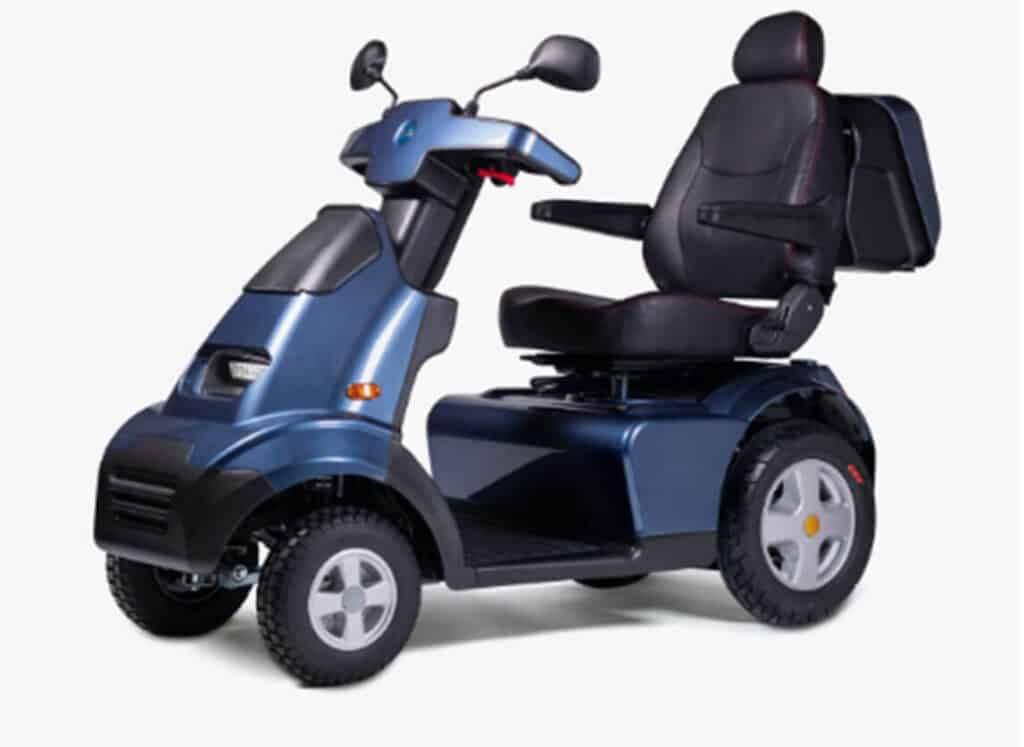
Larger Class 3 mobility scooters are excellent for users who regularly travel longer distances on pavements and roads.
Their size can become a disadvantage on public transport.
Large seats, longer chassis, bigger wheels, canopies and wider turning circles can make some road scooters unsuitable for trains even when the user can physically reach the platform.
National Rail’s operator restrictions are largely determined by whether the scooter can fit into the available space and manoeuvre safely.
If railway travel will only be occasional, owning a larger scooter may still make perfect sense.
If train travel is going to be a regular part of your lifestyle, however, portability should be one of the specifications you consider when choosing your next scooter.
Folding or Dismantling: Which Is Better for Train Travel?
Both designs can work well, but they solve slightly different problems.
A folding mobility scooter can usually be collapsed relatively quickly and may remain as one main unit. This can be convenient when transferring between trains or moving between public transport and a car.
A dismantling mobility scooter separates into several pieces. Individual components can therefore be much lighter to lift, although assembling and dismantling the scooter takes additional time.
For example, Affordable Mobility’s lightweight range includes the Pride Apex Alumalite, which separates into five pieces, while the SupaScoota uses a split-frame design where the heaviest component is approximately 10kg.
Think about who will actually handle the scooter.
A 20kg scooter may be described as lightweight compared with a conventional model, but 20kg can still be difficult for some people to lift. If you travel alone, the weight of the complete folded scooter becomes especially important.
Plan for Your Destination Too
Getting onto the train is not the end of the journey.
Consider what happens after you arrive.
Check whether your destination station has step-free access from the platform you will arrive at and whether assistance is available at the time of day you are travelling.
Then think about the journey beyond the station.
Will your scooter have enough battery range? Are there steep hills? Will you be travelling over rougher surfaces? Do you need to carry shopping or luggage?
A very lightweight travel scooter may be ideal for stations and public transport but may have different range, comfort and terrain capabilities from a larger pavement or road scooter.
Choosing the right mobility scooter therefore means balancing portability against your everyday mobility requirements.
Train Travel Can Be Much Easier With the Right Preparation
Taking a mobility scooter on a UK train is entirely possible for many passengers, and services such as Passenger Assist can make railway travel considerably more accessible.
The important point is not to assume that every operator, station or scooter follows exactly the same rules.
Check your scooter’s measurements, identify the train companies involved, look at station accessibility and find out whether a permit is required before travelling.
If you expect to use public transport regularly, a compact folding, lightweight or boot mobility scooter can also make journeys far easier to plan.
At Affordable Mobility, we offer a wide selection of portable mobility scooters including folding, automatic-folding and lightweight dismantling models. Our team can help you compare scooter weight, folded size, range, user capacity and ease of handling so you can choose a model that suits both your everyday mobility and your travel plans.
For train journeys specifically, always confirm the latest carriage requirements with the railway operator before setting off, as individual train company policies and permitted dimensions can change.